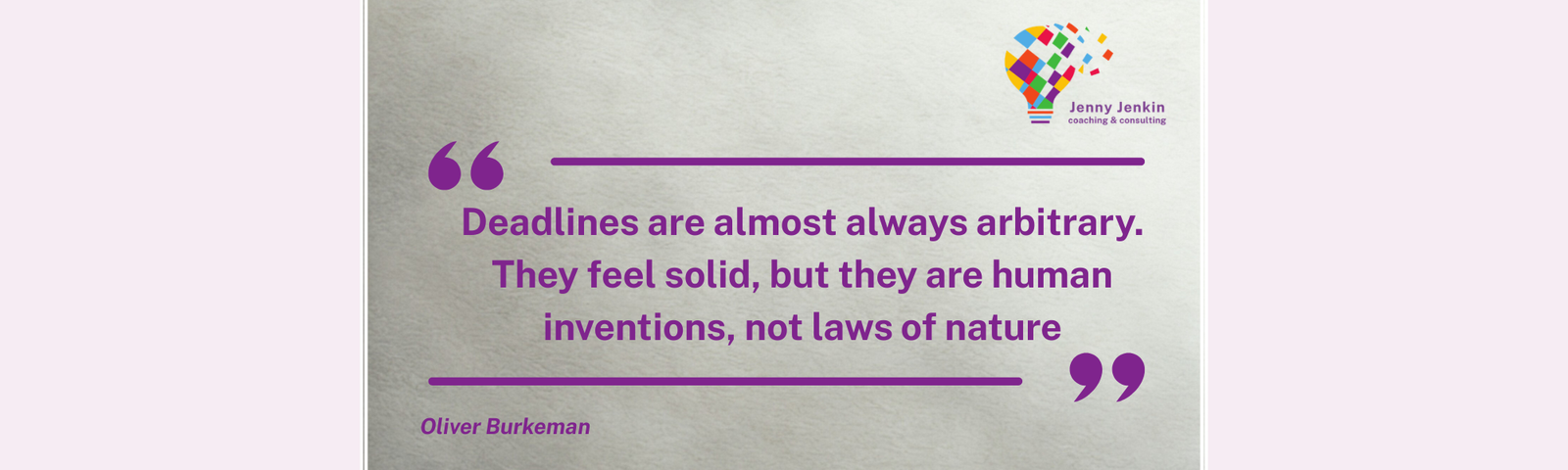
Deadlines are not priorities.
And treating them as if they are is a reliable way to manufacture stress.
I don’t have a problem with deadlines per se. I set them for myself all the time.
The problem starts when deadlines become a proxy for importance.
They’re often set for all sorts of reasons:
- Because a committee cycle demands it.
- Because it suits your boss’s diary.
- Because someone thought it might be “motivating”.
None of those automatically make something important.
And yet deadlines have an powerful ability to hijack our nervous systems. And yet, if you strip them right back, some of the stress they create starts to look faintly absurd.
Here’s a trivial example. If I’m driving somewhere, I’ll often decide I want to arrive by a certain time. Let’s say 3 pm. So I set off at midday, giving myself plenty of time.
Then the inevitable happens. Traffic. Fuel stops. A late departure due to a call.
And I find myself increasingly stressed in my determination to meet the original- entirely arbitrary – 3pm deadline. Which was driven by a faint sense of ‘it would be nice to get there by 3 to give myself time to (insert ‘stuff’ here)’
These days I – mostly – catch myself. I ask myself a simple question – what actually happens if I arrive after 3? If I am brutally honest with myself, it is usually, very little.
Once I mentally ditch my attachment to the time, the stress drains away. I drive more safely. I arrive with a clearer head. Feels rather good.
So what about work deadlines I hear you cry? Well, the same principle applies. Really.
Dig a little, and I suspect you’ll find a good chunk of them fail the ‘is this truly worth getting stressed about?’ test.
I’m not talking about immovable, external deadlines – regulatory, legal – intrinsically consequential ones.
I’m talking about the softer deadlines we’ve invented. And then started being treated as sacred, creating a bizarre false urgency.
If you’re still sceptical – and I get that – try this:
1 Review your to-do list and, for a moment, strip away every deadline.
2 Then properly assess what really matters most. Using your own criteria, but likely including strategic importance and impact on others. Students. Clients. Colleagues. And, yep, senior leaders too – but don’t automatically overweight them.
Only once you’re clear on your real priorities do you ‘re-overlay’ the deadlines.
You’ll often find they don’t neatly align – which tells you something.
Use this to choose your top five priorities for the month. Not because a date says so, but because they actually matter.
That leaves the final, uncomfortable step – dismantling the deadlines you no longer see as valid.
Talk to the owner of the deadline. Explain the prioritisation. Explore alternative ways of delivering that don’t clash with what genuinely matters.
And the next time a deadline lands on your desk, or you’re tempted to set one yourself, do pause. Challenge it. Ask what the real consequences of not meeting it would be. And decide accordingly.
Deadline driven? Never again.
🔸 🔸 🔸
I work with women leaders in HE to help them feel in control so they can thrive in their careers and lead with confidence and impact.
DM me if you’d like to chat, or book a free call from the link in ‘featured posts’ in my LinkedIn profile.ply the words, plus the featured image and the excerpt….we’ll show exactly how to do that.