
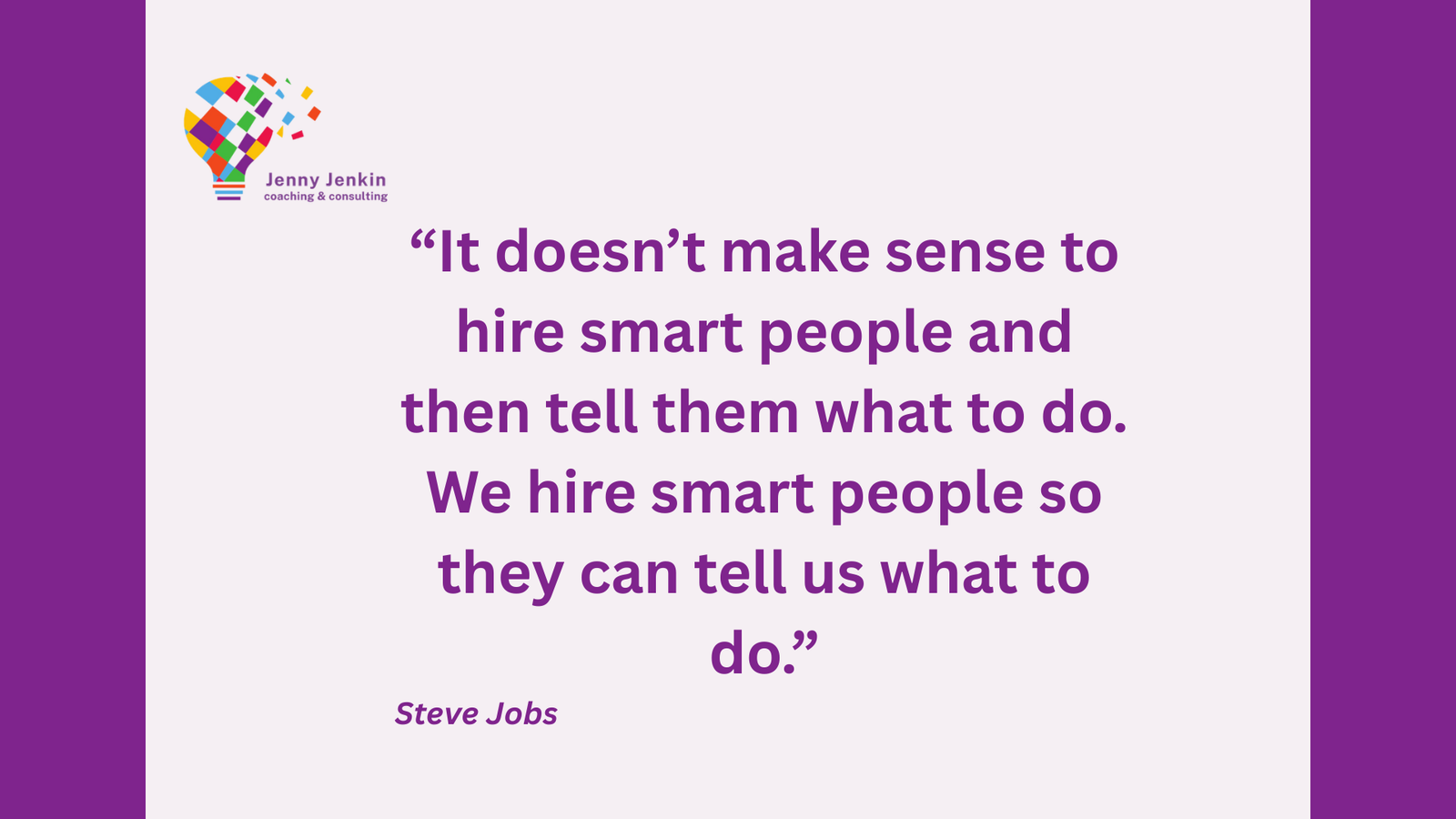
Great leaders surround themselves with people who are more expert and knowledgeable than they are.
That’s the received wisdom, is it not? Steve Jobs was clearly a fan of this golden principle.
This leadership ‘no-brainer’ has also become a default assumption in higher education, where the sheer breadth and depth of professional expertise across any sizeable university makes it genuinely impossible for a single leader to hold all the knowledge. And if you think about most Vice-Chancellors, who (rightly) don’t know the raw details of the regulated data returns, or the process for changing the Articles, you’ll get what I mean.
And as a rule of thumb, it’s a good one. You’d have to be superhuman to be the expert in everything your portfolio demands, and any attempt to pretend otherwise tends to end badly for everyone, especially you.
But there’s a massive flaw in the principle. It assumes a tidy world in which talented experts welcome their new leader warmly, share key information fully and see the value of collaborative, joined-up leadership. Not to mention a leader who is wholly without ego, steeped in wisdom and has the judgement of Solomon. In my experience, the world is considerably messier than that. And people are far more complex.
An Illustration
Try this scenario. You’ve landed a great new job. You are now leading expert teams across, say, ten different professional disciplines. You’ve come through a particular route with a unique bundle of skills which was never going to be an exact fit with your new portfolio. Nor should it be. That’s rather the point.
In the early weeks, you’re learning at pace, building relationships, trying to understand the landscape and the politics, and working out who does what and why. You’re meeting people who know far more than you do about their particular patch, and you’re doing your best to listen well, absorb quickly and (perhaps performatively) demonstrate that you bring something of real value to the table.
And then the honeymoon period slides away quickly. One team member holds tightly to information in their sphere. Its tempting to see this as a malicious act, but in my experience, it’s more likely to be borne from a combination of fear, long habit and perhaps a default concern that you ‘wouldn’t get it’ if they shared the full picture. They’ve been the expert in this area for fifteen years and, in truth, the arrival of a generalist leader who may or may not value their deep specialism feels like a potential threat. After all, knowledge is power, right? So they control what flows upward and outward, sometimes without realising they’re doing it.
Another team member overshares, overpromises and is remarkably keen to secure early access to the new boss. They’ve spotted an opportunity to gain influence and they are running at it with some enthusiasm. You find yourself deluged with information, requests for one-to-ones and unsolicited opinions about colleagues, and it takes a while to work out what is genuinely useful and what is positioning.
A third seems wholly perplexed by the new grouping. They don’t see why anything beyond their immediate team has any bearing on what they do and how they do it. The broader portfolio structure feels like an organisational contrivance rather than a meaningful leadership framework, and their engagement with the wider agenda reflects that. They’re not hostile, just disengaged from the bigger picture.
All perfectly valid positions with entirely understandable intent. But all of them cause dysfunction. And all of them can trigger something deeply uncomfortable in you as the incoming leader.
Because when someone withholds information, it can reinforce the nagging thought that perhaps you really don’t know enough to lead this area. When another bombards you with detail you can’t yet contextualise, the overwhelm can make you question your own capacity. And when a colleague fails to see the point of your role entirely, it lands somewhere close to ‘why are you here?’ None of which is great for the confidence of even the most seasoned leader.
And So Begins The Dance.
Your unease can directly affect the way you engage with your team which in turn reinforces their original concerns, which deepens the pattern, which entrenches the dynamic. The information hoarder senses your hesitation and holds on even more tightly. The over-sharer spots a gap in your confidence and doubles down. The disengaged colleague takes your cautious approach as confirmation that you have nothing to offer their world.
I have seen it play out repeatedly, in universities of all sizes and shapes, and I’ve lived it myself, more than once. It is one of the most common and least discussed challenges of senior leadership in higher education, and the conventional wisdom about building expert teams gives us absolutely no tools for navigating it.
The Human Dimension.
The reality is that politics, the power dynamics, the deeply ingrained behaviours and the emotional undertow that sit beneath the surface of every team, no matter how talented and well-intentioned its members. And if you have been ‘parachuted in’, particularly post-restructure, you can add a smidge of trauma to the list.
Team member expertise does not live in a vacuum. It comes gift-wrapped in ego, in history, in anxiety about what the new leader might change, and in longstanding patterns of relating to authority that predate your arrival by years. If you don’t attend to that layer, you will find yourself technically surrounded by brilliant people and functionally unable to draw on their brilliance when it matters most.
Some Ideas
Three suggestions for you if you find yourself in, or anticipate this scenario:
Firstly, notice the dynamic explicitly and resist the strong pull to internalise it as a personal failing. It’s not about you. The fact that a team member is withholding information is usually about their relationship with the system, not you. That knowledge alone can be enough to interrupt the spiral by shifting your feelings about the situation and your resultant behaviour.
Secondly, create genuine conditions of safety rather than assuming they exist. If people don’t yet trust you (and why would they at first?), they won’t instinctively share what they know, and you can’t shortcut that process no matter how collaborative your intentions. Trust is built through consistency, through showing that you value what people bring rather than simply needing what they know, and through the willingness to be open about – and at ease with – what you don’t yet understand or are not an expert in.
Third – recognise and expressly appreciate people’s talents and actions as you are all acclimatising to the new way of working. An honest thank you, helpful and positive feedback – all of this builds trust and openness.
And finally, be alert to the dance. Watch for the moments when your own responses shift in ways that aren’t serving you or the team. For example, that subtle avoidance of a colleague whose specialism is way outside your experience. Or an over-reliance on the enthusiastic one who makes you feel less of an imposter. Or the almost imperceptible withdrawal from the person who seems uninterested or seems to see you as an irrelevance.
All of these are deeply human, all are OK, and all can be interrupted if you get super curious rather than affronted.
Finally
Building a successful team of people who know more than you do is undoubtedly one of the hallmarks of great leadership. But it requires far more than good recruitment. It necessitates you leading through the complexity of real human relationships, to tolerate the discomfort of not knowing, and to keep showing up with curiosity rather than retreating into the safety of control. And in this age of ai, this is ever more important. Our very humanity, used wisely, is what enables us to excel.
And that, in my experience, is a skill that rarely features on the leadership development curriculum but deserves a great deal more airtime than it currently gets.
What’s your experience? I’d love to hear how you’ve navigated leading people who know more than you, and what helped you find your footing.